Hello 2015! I am only accepting ONE or TWO births per month, as the birth photographer and doula. Doula services are available as an addition to photography and as a stand alone service. I offer a complimentary meeting to anyone interesting in my services. Please email me if you'd like to chat! robin@birthblessingsphotography.com

Showing posts with label Judaism. Show all posts

Tuesday, March 30, 2010

Passover

We observe Passover. Not in the orthodox sense, but in a modern Christian way. WHY? Well, read more HERE.IMG_6402

What we do

Friday, April 10, 2009

Seder meal

Traditionally the Seder meal is prepared on the first day of Passover, and in some traditions the second. I couldn't get it together in time, but better late than never. We had our Seder meal tonight, on Good Friday. I bought our lamb at Henry's and prepared the crock pot before taking off to Church. Owen helped me =)

Mike got us unleavened bread from Jerusalem, and very yummy kosher Kedem grape juice (instead of wine) from the Jewish section of Vons. Yeah Vons!
Here is my Seder meal: Lamb stew, matzo, and kosher grape juice. Mmmmmm
I told the kids it was special lamb meat and flat bread just like Jesus ate.
Owen was curious about this new tasting meat...
....and decided, "it's good mommy!"
Jackson devoured his so fast I didn't even get a picture.
What is the Seder meal?
(answer from www.christianseder.com)
Seder
is the traditional Passover Week Dinner celebrated by the Hebrews since the Exodus. It is the Hebrew Thanksgiving, giving thanks to God for deliverance and redemption.

Seder is also called the Passover Dinner, commemorating the protection of God as the Angel of Death passed over every family protected by the Blood of the Paschal Lamb.

Seder is Bible Study. It is in this family setting that Jewish children were first introduced to the Book of Exodus as the adults gained further insight. We refer to this kind of instruction as multimedia, as all five senses are involved to make this study an unforgettable event.

Seder is that famous Dinner called The Last Supper, hosted by Jesus for His disciples. It is probable, based on The Gospels, to assume that Jesus celebrated every Seder of His life in Jerusalem. Seder, as the setting for Jesus' Last Supper, was the event Jesus choose to announce The New Covenant. And it was at this Seder that Jesus asked all of us to do this in remembrance of Him. Many of us have done part of the Seder at our various Communion Services, but the entire ceremony will bring us a profound sense of meaning.

Seder is the Feast of Unleavened Bread mentioned twice in Luke's Acts of the Apostles (12:3 and 20:6). The days of Unleavened Bread were mentioned in connection with Peter in Jerusalem and Paul in Greece, and both citations are followed by great miracles. I think that it is safe to say that both Peter and Paul celebrated Seder and encouraged others, both Jews and Gentiles, to do this also.

Seder was the basis of the early Church's Lord's Day worship service. It was referred to as the Agape Feast and Eucharist. Agape is the Greek word for Christian Love, that Love we have for one another. Eucharist is a transliteration of the Greek word which means to give thanks to God, implying that Thanksgiving is an obligation for the works of God. Our early Church experienced miracles and miraculous movements of the Holy Spirit. Our Christian ancestors were united in One Love, One Christ, and One Mind as they grew from obscurity to a Worldwide Church.

The Seder dinner is as Christian as it is Jewish. It is the focal point where we bring together our common heritage. We, as Christians, are heirs of Abraham through Faith and children of God through Christ.

Thursday, April 9, 2009

Passover

Passsover 2009 is from April 8th (sundown) to April 16th (sundown)
The Passover Feast: A prophetic picture of the atoning death of Christ
(article from this website)
The coming of the Messiah is the central theme of the Old Testament. From the very beginning, right after the serpent deceived Eve in the Garden of Eden, God speaks of the One who is coming that will bruise the serpents’ head (Genesis 3:15). In the book of Psalms we read where King David prophesies about the death of Christ saying, “They pierced my hands and my feet… And for my clothing they cast lots” (Psalm 22:16-18). The prophet Isaiah foretells the atoning death of the Messiah and compares Him to “a lamb that is led to slaughter” (Isaiah 53:5-7). And John the Baptist, the last of the Old Testaments prophets, when he saw Jesus coming toward him declared, “Behold the Lamb of God who takes away the sin of the world!” (John 1:29).
The record of the Old Testament makes it clear that the Messiah was born to die. The
Father sent Him from heaven for this purpose. It wasn’t plan B. It wasn’t because something went terribly wrong. At exactly the right time in history, Jesus Christ, the Son of God, was born, became a man and in obedience to His heavenly Father’s will; died on a cross to take away the sin of the world (Galatians 4:4-5). Jesus said, "Do not think that I came to abolish the Law or the Prophets; I did not come to abolish but to fulfill” (Matthew 5:17). Shortly after His resurrection, Jesus appeared to two of His disciples as they were traveling on the road to Emmaus and “beginning with Moses and with all the prophets, He explained to them the things concerning Himself in all the Scriptures” (Luke 24:27). Jesus did indeed fulfill all that was written and prophesied about Him in the Old Testament.
The Passover Feast is one of these amazing prophetic pictures that Christ has fulfilled.
The apostle Paul calls these Old Testament events “shadows of things to come.” And goes on to explain that “the reality, the substance, the solid fact of what is foreshadowed, the body of it, belongs to Christ” (Colossians 2:17 Amplified Bible).
Messiah means Christ or the anointed one
Just as the Passover was the first feast that the people of Israel were commanded to
observe; so is Christ‘s atoning death on the cross the first truth we must believe if we are
to be free from slavery to sin, saved from the judgment it deserves and recipients of eternal life (John 3:16-19, Romans 6:23, 10:9-10). It is not enough to just know and understand that Christ has fulfilled all these things; we must believe in our hearts that Christ is truly our Passover Lamb.
Your Lamb Shall Be Unblemished
Speak to all the congregation of Israel, saying, 'On the tenth of this month they are each one to take a lamb for themselves, according to their fathers' households, a lamb for each household. Now if the household is too small for a lamb, then he and his neighbor nearest to his house are to take one according to the number of persons in them; according to what each man should eat, you are to divide the lamb. Your lamb shall be an unblemished male a year old; you may take it from the sheep or from the goats. (Exodus 12:3-5)
At the beginning of Passover week, on the tenth of the month, Jesus entered Jerusalem to
the sound of the multitudes shouting, “Hosanna to the Son of David” (Matthew 21:1-11, Mark 11:1-10, Luke 19:29-40). Jesus then entered the temple and with authority drove out those who were buying and selling! “My house shall be called a house of prayer,” he proclaimed. These events correspond with taking the Passover lamb into the house on the tenth of the month (Exodus 12:3). The Israelites were to take a year old, male lamb into their households until the fourteenth day of the month in order to inspect it for flaws. It had to be a lamb without blemish (Exodus 12:5). Jesus, the Lamb of God, had come into the house and over the next few days the chief priests, the scribes, the elders, the Pharisees and the Sadducees would all confront and question Him, but they would find no flaw (Luke 20:1-8, 19-26; Matthew 15:22-40, 21:23-27). Even after they arrested Jesus and brought him into the house of the high priest, they could only bring false witnesses against Him (Mark 14:53-59). And finally, when they brought Jesus before Pontius Pilate to have Him condemned to death, Pilate could only state the truth saying,
“I find no guilt in Him” (John 18:38). The Lamb was indeed unblemished (Hebrews 4:15). Atoning or atone means to appease, reconcile or propitiate (1 John 2:2, 4:9-10)
Also during this time, while in the house of Simon the Leper, a woman came to Jesus and
anointed Him with a very costly perfume. This beautiful and extravagant act of worship reveals many truths about Jesus. In the context of this study, it shows us that the Christ, the anointed one, was being prepared for His burial after becoming the sacrificial Lamb (Matthew 26:6-13; Mark 14:3-9).
A New Covenant
Moreover, they shall take some of the blood and put it on the two doorposts and on the lintel of the houses in which they eat it. They shall eat the flesh that same night, roasted with fire, and they shall eat it with unleavened bread and bitter herbs. Do not eat any of it raw or boiled at all with water, but rather roasted with fire, both its head and its legs along with its entrails. And you shall not leave any of it over until morning, but whatever is left of it until morning, you shall burn with fire. (Exodus 12:7-10)
Not long before Jesus and His disciples were gathered for the last meal they would have
together before His death, Judas Iscariot had already plotted to betray Him (Matthew 26:14-16; Mark 14:10-11; Luke 22:1-6). Knowing that He could not be able partake of the actual Passover meal with His disciples, Jesus shared a meal with them that explained that He was about to become the Passover meal. The New Covenant was about to be instituted and Jesus was expressing this through what we call the Lord's Supper (Matthew 26:26-30; Mark 14:12-26; Luke 22:1-20). Just as the Passover lamb’s blood was shed and put on the doorpost and lintel to save the Israelites from the last plague, so Jesus’ blood was about to be shed and His body broken for the salvation of the whole world.
Kill it at Twilight
You shall keep it until the fourteenth day of the same month, then the whole assembly of the congregation of Israel is to kill it at twilight. (Exodus 12:6) At the very time that the Passover lambs were being killed, Jesus was being crucified (Matthew 27:46-50; Mark 15:34-37; Luke 23:44). While all of Jerusalem was busy preparing the Passover meal with the lambs that were being sacrificed, Jesus was uttering His last words, “It is finished” (John 19:30). What was finished was God’s plan for the salvation of all people through the death of His Son. All that the Passover represents had been fulfilled in Christ (1 Corinthians 5:7).

The Blood of the Lamb
For I will go through the land of Egypt on that night, and will strike down all the firstborn in the land of Egypt, both man and beast; and against all the gods of Egypt I will execute judgments—I am the LORD. The blood shall be a sign for you on the houses where you live; and when I see the blood I will pass over you, and no plague will befall you to destroy you when I strike the land of Egypt. (Exodus 12:12-13)

Just as the blood of the Passover lamb saved the Israelites from the judgments of God and
redeemed them from slavery, so does the blood of Christ save all who believe from the judgment of God and redeem them from slavery to sin (1 Peter 1:18-20). The blood of the Lamb cleanses us, gives us a brand new start and frees us from a guilty conscience (Hebrews 10:22).
Feast of Unleavened Bread
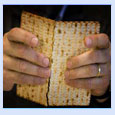
In the first month you are to eat bread made without yeast, from the evening of the fourteenth day until the evening of the twenty-first day. For seven days no yeast is to be found in your houses. And whoever eats anything with yeast in it must be cut off from the community of Israel, whether he is an alien or native-born. Eat nothing made with yeast. Wherever you live, you must eat unleavened bread. (Exodus 12:18-20)
The Feast of Unleavened Bread began the night of the Passover meal. Leaven represents
sin. During Passover week the Israelites would search their houses to make sure there was no leaven anywhere in their homes. They would then make bread for the feast without any leaven. The unleavened bread represents how Christ has made us free of sin and how he wants us to continue to live and celebrate our new life, “with the unleavened bread of sincerity and truth” (1 Corinthians 5:7-8).Feast of the Firstfruits
Celebrate the Feast of Harvest with the firstfruits of the crops you sow in your field. (Exodus 23:16) The day that Jesus was resurrected was actually the day that the Feast of the Firstfruits was celebrated (Exodus 23:16). The Israelites would bring the first fruits of their harvest to the temple as an offering. Jesus fulfills this on that very day by being the first of those to be resurrected from the dead (1Corinthians 15:20-23). Jesus also keeps His own words when he said, “For as Jonah was three days and three nights in the whale’s belly; so shall the Son of man be three days and three nights in the heart of the earth” (Matthew 12:40). We can follow the sequence of events described in the New Testament that lead us through these three days. The day after Christ was crucified was the High Sabbath or the Passover Sabbath (Mark 15:42). Being a Sabbath day, the Israelites were commanded to cease from all labor. They would have prepared all the unleavened bread before this day. The following day, being a normal workday, we are told that some of the women who followed Jesus bought spices to take to His tomb to anoint Him (Mark 16:1). The next day they rested on the regular weekly Sabbath, the last day of the week (Luke 23:56). Then the following day, the first day of the week, they came to the tomb and found the stone rolled away from the entrance and when they went in they saw a young man dressed in a white robe who said, “You are looking for Jesus the Nazarene, who was crucified. He has risen!” (Matthew 28:16; Mark 16:2-6; Luke 24:1-2; John 20:12).
Christ indeed had risen from the dead having fulfilled the true meaning of the Passover Feast, the Feast of Unleavened Bread and the Feast of the Firstfruits!
Silly boys havin' a good time reading their Bible stories

Sunday, January 25, 2009

Are Jewish Holidays for Christians?

To fully comprehend our Christian faith, we should know about this fascinating heritage. We study a Hebrew book-written by Hebrews; we serve a Hebrew Lord-who had Hebrew disciples; we desire to follow the first century church-which was first predominately Hebrew; and through Christ, we are grafted into a Hebrew family! It makes sense to study the Hebrew culture.

This is a refreshing, new, exciting way to view the Bible! Much of the Bible is mysterious to most Americans. The perplexing phrases, puzzling actions, the sometimes difficult-to-understand words of Jesus, unconventional holidays, and parables are only understood with an awareness of the Hebrew culture. A Christian's roots are deep in Judaism through Christ, all the way back to Abraham! And if ye be Christ's, then are ye Abraham's seed, and heirs according to the promise (Gal. 3:29).


Paul wrote to the Gentile believers in Colossians 2:16-17 that the holidays are a shadow of things to come. Each of the spring holidays is a picture of Christ's first coming. Jesus was sacrificed for our sins on Passover, buried on Unleavened Bread, and arose on Firstfruits. The fall holidays are a picture of His second coming and the beginning of the Messianic reign.

Each of the biblical Jewish holidays teaches us about our wonderful relationship with God. His whole redemption story is portrayed for us in these festivals. Passover pictures salvation or deliverance from Egypt (flesh or sin). Unleavened Bread shows us that God saved us in order that we may be holy and set apart for Him by putting off the old sin nature. Firstfruits teaches us the purpose of salvation: fruitfulness in the Kingdom of God (John 15:1-5) and putting on the new man, the nature of God (Eph. 4:24). The Feast of Weeks instructs us further concerning the kind of fruit we must bear spiritual fruit (Gal. 5:22-23) through the power of the Holy Spirit.

Each Holy Day Reveals Something About Christ

feast of passover
Passover

Pesach

Nisan 14

Purpose: Remembering the deliverance from Egyptian bondage. An unblemished firstborn male lamb was sacrificed and its blood poured on the altar. A lamb was selected for each family, and four days before the lamb was to be slain it was brought into the home for a four-day examination period.

Messianic Significance: Jesus is the sacrificial lamb who died for our sins. On Nisan 14 at the exact time the lamb was to be slain, Jesus was slain. Jesus also had a four-day examination period before the religious leaders and was found without blemish.


feast of unleavened bread
Unleavened Bread

Nisan 15

Purpose: Leaven symbolizes sin. Unleavened Bread speaks of sanctification. God told the Jews to cleanse all leaven from their homes and eat only unleavened bread, matzah, for seven days, symbolizing a holy walk with Him.

Messianic Significance: Jesus is the "Bread of Life" without sin. Born in Bethlehem. In Hebrew, Bethlehem means house of bread. Just as matzah is striped and pierced, so was the Messiah. This Feast falls on the day Jesus was buried.


 feast of firstfruits
Day of Firstfruits

Nisan 17

Purpose: The first of the barley harvest was brought as an offering to the priest in the Tabernacle/Temple. The priest would present the first of the harvest unto the Lord by waving them back and forth. This reminded the Hebrews that God gave them the land, and the harvest belonged to Him.

Messianic Significance: Jesus is the Firstfruits (1 Cor. 15:20-23). Jesus' resurrection marked the beginning of the harvest of souls. John 12:23-24,32 shows Jesus was likened to a grain of wheat falling to the ground and dying to produce a great harvest. Jesus arose on Firstfruits.


feast of Shavout or pentecost
Feast Of Weeks

Pentecost

Shavuot

Purpose: Fifty days after the Feast of Firstfruits, two loaves of leavened bread are presented to God. Also a reminder that the Jews were slaves to Egypt (Deut. 16:9-17). The giving of the Torah to Moses on Sinai took place this day. Three thousand were killed that day.

Messianic Significance: Fifty days after Jesus arose, a group of Messianic Jews received the Holy Spirit. Jesus said "Unless I go, the Holy Spirit will not come. But when I go (Firstfruits- His resurrection) I will send the Holy Spirit unto you." God wrote the law (Torah) on the hearts of the believers. Three thousand souls were saved.


Feast of Trumpets

Rosh Hashanah

Tishri 1

Purpose: The Jewish New Year begins the high Holy Days in the Jewish month of Tishri (corresponding to September or October.) A celebration of the spiritual birthday of the world or creation. Blowing of the trumpets and coronation of the King.

Messianic Significance: Possibly depicts the rapture of the church, a regathering of believers at the sound of the trumpet (1 Thess. 4:16-18; Rev. 19) and judgment of the wicked, or possibility is that this is the day of the second coming. Jesus will be King of earth.


yomkippur
Day of Atonement

Yom Kippur

Tishri 10

Purpose: The holiest day in the Jewish year is spent in fasting, prayer, and confession. This was one gracious day a year given by God that each individual could receive forgiveness. The high priest entered the holy of holies to make atonement for the nation by sacrificing animals including two goats.

Messianic Significance: Christ our Messiah was displayed as our sacrifice. We can use this as a time of self-searching, repentance, and recommitment to God. The goats represent Jews and Gentiles. Possibly points to the day of the Messiah's physically returning to earth. Or it is possible this is the Judgment Day.


Feast of Tabernacles

Sukkoth

Tishri 15

Purpose: God told the people they should live in booths for seven days so that the generations would know that His people lived in booths when He brought them out of Egypt. Each Sukkoth, the Jews build and dwell or eat in booths or temporary dwellings for seven days. A joyful celebration!

Messianic Significance: Christ is our tabernacle or dwelling place (John 14:14). May represent the 1000-year reign of Christ on earth. Many believe Jesus was born during this Feast because He was born in the late fall in a "booth". Or this is possibly when we tabernacle (dwell) with God in heaven.


NOTE: Replacement Theology teaches that the Church has replaced the Jewish people and is now the "new Israel." Those promoting this theory believe God rejected the Jewish people because of their rejection of Christ. This doctrine is imbedded in many Christian denominations.

It is critical for Christians to understand that we do not replace natural Israel in God's plan. God did not made a mistake in creating Judaism and then in utter exasperation send His son to correct it 4,000 years later.

This doctrine has been at the forefront of anti-Semitism, Judeo-phobia, and has fully provided fuel for catastrophic historical events such as the Spanish Inquisition, the Catholic Crusades, and the holocaust.

READ MORE ABOUT THAT HERE.

INTERESTED TO READ/STUDY MORE ABOUT THIS? CHECK OUT THIS FABULOUS WEBSITE BiblicalHolidays.com

Saturday, January 24, 2009

Chanukkah 2008

This is our second year celebrating Chanukkah. It fell on December 21st - 29th. Even though it overlapped Christmas, our kids had no problems separating the two and their different meanings. It was extra special this year because my Dad was in town to celebrate it with us. He
said the first line of the blessing in Yiddish - the only prayer he remembers from his childhood.

Each night we say the blessing, light the candles, turn off the lights to enjoy them for a minute, remind Jackson not to blow them out!, and then open a small gift (for the kids only). The candles burn for an hour. Last year they dripped all over, but this year we got higher quality ones that burned perfectly with no mess.
The center candle is called the 'shammus.' "Why the shammus candle? The Chanukkah candles are for pleasure only; we are not allowed to use them for any productive purpose. We keep an extra one around (the shammus), so that if we need to do something useful with a candle, we don't accidentally use the Chanukkah candles. The shammus candle is at a different height so that it is easily identified as the shammus." from JewFaq.org.
First night of Chanukkah. Notice the Christmas PJs.
turn off the lights to enjoy
This holiday is by far Jackson's favorite. I mean really, look at the pure joy!
1st night gifts are usually holiday related. This year they got a Chanukkah puzzle and stickers.
Last night - all 8 candles and the shammus burning
cool toy from Costco - sticky blocks

Why would a Christian celebrate Chanukkah? Stay tuned for my next post =)