
 (not my ultrasound pic - but it looked identical!)
I went in for the biopsy on Thursday February 5th. While the doctor was locating the lump, he was contemplating what procedure to do. He told me it was relatively close to the surface and still small enough that he could just remove the entire thing under local anesthesia. I told him that I would prefer that so I didn't have to get poked twice =). So after some Lidocaine injections, "lumpy" (as my coworkers fondly referred to it) was history. The worst part was the 10 minutes of pressure the assistant had to apply afterward. They were impressed by my calm demeanor and sleeplike state during the procedure. I explained that I was utilizing my natural childbirth techniques taught by my Bradley Method class and my prenatal yoga instructor, Liza Janda. Wow, that always sparks up an interesting conversation =)

Definition
Fibroadenomas are benign breast tumors commonly found in young women. Fibroadenoma means "a tumor composed of glandular (related to gland) and fibrous (containing fibers) tissues."
Description
Breast fibroadenomas, abnormal growths of glandular and fibrous tissues, are most common between the ages of 15 and 30, and are found in 10% of all women (20% of African-American women). They are found rarely in postmenopausal women.
Described as feeling like marbles, these firm, round, movable, and "rubbery" lumps range from 1-5 cm in size. Giant fibroadenomas are larger, lemon-sized lumps. Usually single, from 10-15% of women have more than one.
While some types of breast lumps come and go during the menstrual cycle, fibroadenomas typically do not disappear after a woman's period, and should be checked by a doctor.
Causes and symptoms
The cause of breast fibroadenomas is unknown. They may be dependent upon estrogen, because they are common in premenopausal women, can be found in postmenopausal women taking estrogen, and because they grow larger in pregnant women.
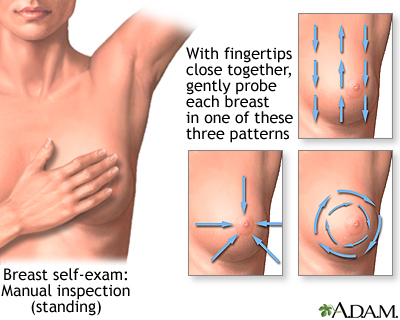
Fibroadenomas usually cause no symptoms and may be discovered during breast self-examination, or during a routine check-up.
Diagnosis
When the doctor takes a complete medical history, they will ask when the lump was first noticed, if there were any symptoms or changes in lump size, and if there is any personal or family history of breast disease.
The doctor thoroughly feels the breasts (palpates). Tests are done, usually including mammography or ultrasound scans, or surgical removal of cells or tissue for examination under a the microscope (biopsy).
Diagnostic tests include:
- Mammogram. An x-ray examination of the breast.
- Ultrasound scan. A technique that uses sound waves to display a two-dimensional image of the breast, showing whether a lump is solid or fluid-filled (cystic).
- Fine-needle aspiration biopsy. A minor procedure wherein fluid or cells are drawn out of the lump through a small needle (aspirated).
- Core biopsy. A procedure wherein a larger piece of tissue is withdrawn from the lump through a larger needle.
- Incisional biopsy. A surgical procedure wherein a piece of the lump is removed through an cut (incision).
- Excisional biopsy. A surgical procedure wherein the entire lump is removed through an cut (incision).
Most insurance plans cover the costs of diagnosing and treating fibroadenomas.
Treatment
Performed usually in outpatient settings, breast fibroadenomas are removed by lumpectomy, or surgical excision under local or general anesthesia. Sometimes lumps in younger women are not removed but are monitored by self-examination, yearly doctor check-ups, and mammograms. Surgery is generally recommended for women over 30, and for lumps that are painful or enlarging.
Alternative treatment
Alternative treatments for breast fibroadenomas include a low-fat, high-fiber, vegetarian-type diet; a reduction in caffeine intake; supplementation with evening primrose oil (Oenothera biennis), flax oil, or fish oil and vitamins E and C; and the application of hot compresses to the breast. In addition, a focus on liver cleansing is important to assist the body in conjugation and elimination of excess estrogens. Botanical remedies can be useful in hormone balancing, as can acupuncture and homeopathy. Massaging the breasts with castor oil, straight or infused with herbs or essential oils, can help fibroadenomas reduce and dissipate, as well as keep women in touch with changes in their breast tissue.
Prognosis
Breast fibroadenomas are not cancerous. The lumps recur in up to 20% of women. A small number of lumps disappear on their own.
Prevention
Breast fibroadenomas cannot be prevented. They can be discovered early by regular breast self-examination.
This is very important! All women should do this on a regular basis!

2 comments:
Wow Robin...I'm so glad you are so aware of your body. I need to be better about self-examinations.
Glad it's benign!
Post a Comment